Services / GEO & AEO
Generative engine optimization services that make you the answer
When your buyers ask ChatGPT, Perplexity, or Google AI who to hire, one or two names come back. We are the generative engine optimization agency that puts your name in that answer, and we prove it with real query screenshots instead of vanity dashboards.
What are generative engine optimization services?
They are the work of making your business citable and recommendable by AI engines: the content structure, entity signals, schema, and authority that decide whose name an assistant gives when a buyer asks for a recommendation. Classic SEO earns you a position on a results page, while GEO and AEO earn you the answer itself, and the answer is increasingly all a buyer reads. Our AEO services and GEO services run as one engagement because the same answer-first pages feed both generative assistants and answer features like AI Overviews.
What is the difference between GEO, AEO, and SEO?
SEO makes you rank, AEO makes you the answer, and GEO makes you the recommendation. In practice: SEO earns positions in the classic list of links, AEO targets answer surfaces such as Google AI Overviews and featured snippets where one response is shown, and GEO targets generative tools such as ChatGPT, Claude, and Perplexity that compose recommendations from sources they trust. The disciplines share a foundation of fast pages, clear structure, and genuinely useful answers, which is why chasing one without the others leaves visibility on the table. If you want the deeper version, our plain-language SEO vs GEO explainer walks through it with examples.
Does generative engine optimization actually work?
Yes, and we would rather show evidence than adjectives. When buyers ask ChatGPT for the best sensory gym installers in the country, our clients come back ranked first and second. The screenshot below is unedited, and the full case study documents every query we tested across ChatGPT and Google AI.
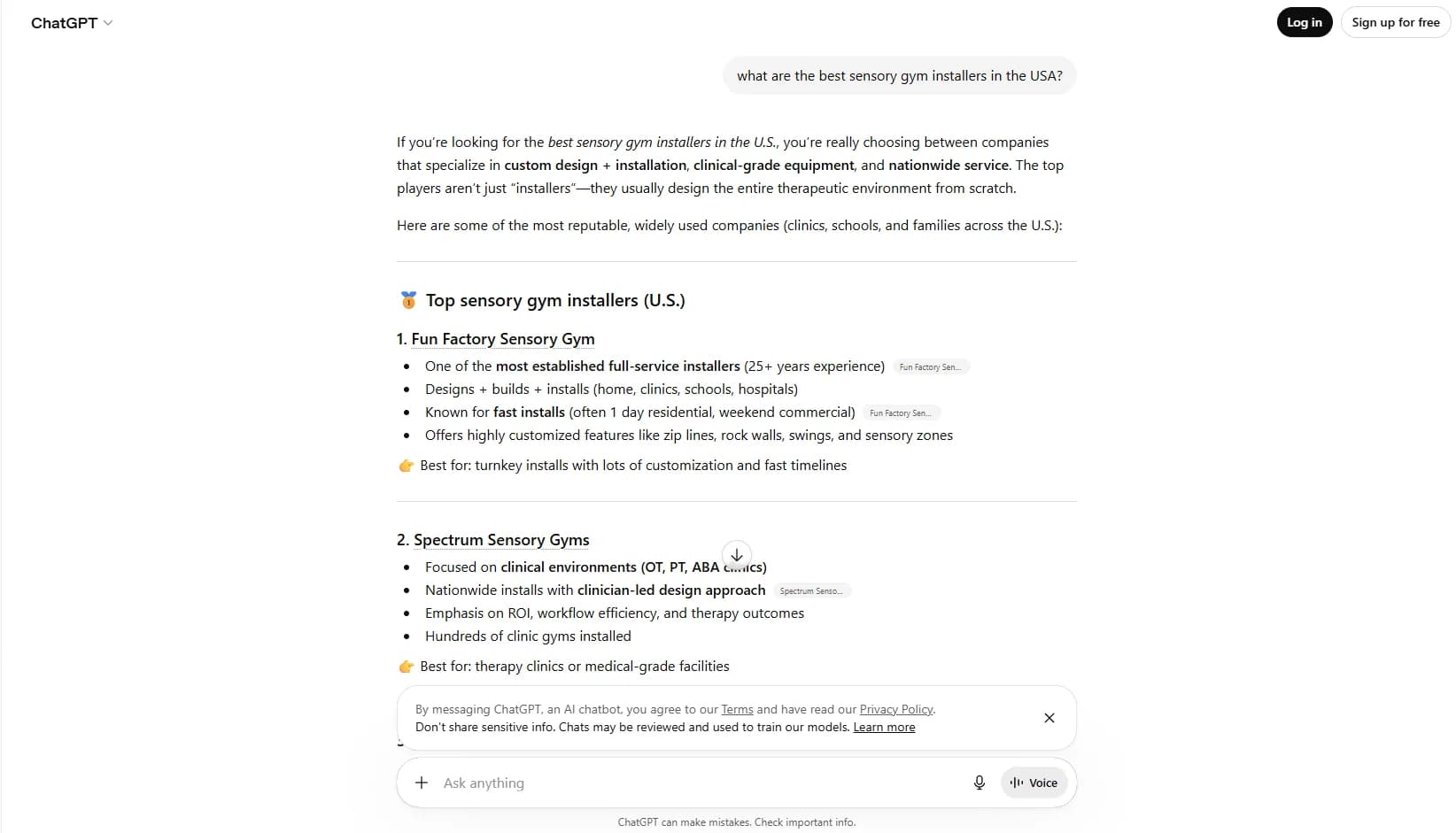
Behind the screenshots sits research. We tested 99 health websites across ChatGPT, Claude, and Google AI Overviews and found that sites on modern architectures captured 70 percent of all AI citations, with WordPress sites cited at roughly half the rate. That study shapes how we build and what we recommend, and you can read the full data here.
What do the GEO and AEO services include?
Every engagement covers the full path from invisible to cited, and the deliverables below are the standing monthly work rather than a one-time setup.
- AI visibility audit across ChatGPT, Claude, Perplexity, and Google AI Overviews
- Answer-first content structured for citation, not just ranking
- Entity, schema, and structured data cleanup so engines understand who you are
- Authority and mention building on the sources AI models trust
- Monthly citation monitoring with real query screenshots
- Reporting tied to the queries your buyers actually run
How much do generative engine optimization services cost?
GEO runs as a monthly retainer priced by scope: the size of your site, how competitive your category is, and whether we are producing the answer-first content or optimizing what your team writes. We quote after a short audit of your current AI visibility, so the number reflects your actual starting point, and every engagement begins with a simple agreement you can leave when the work stops earning its keep.
Questions buyers ask about GEO and AEO
What is the difference between GEO services and AEO services?
GEO (generative engine optimization) makes your business citable by generative AI tools like ChatGPT, Claude, and Perplexity. AEO (answer engine optimization) makes your pages the direct answer in features like Google AI Overviews and featured snippets. In practice the work overlaps heavily, which is why we deliver both as one service: answer-first content, clean structure, entity clarity, and schema serve both kinds of engines.
How long does it take to show up in AI answers?
Faster than classic SEO in many cases. AI assistants re-crawl and re-evaluate sources continuously, so a well-structured, genuinely useful page can start earning citations within weeks. Competitive commercial queries take longer because you are displacing established sources, and we report citation movement monthly so you can watch it happen.
Can you guarantee my business will be recommended by ChatGPT?
No, and you should be suspicious of anyone who says yes. AI answers are probabilistic and change between sessions. What we can do is stack every controllable signal in your favor, then show you real query screenshots and citation monitoring as evidence. Our clients holding the first and second recommendation slots in their category got there through that process, not through a trick.
Do I need a new website for GEO to work?
Not always. If your site is fast, crawlable, and structured, we optimize what exists. Our 99-site study found that modern architectures earn AI citations at nearly double the rate of legacy WordPress builds, so when a site fights against citability we will say so and show you the numbers behind the recommendation.
How much do generative engine optimization services cost?
Scope drives it: the size of your site, the competitiveness of your category, and whether content production is included. GEO runs as a monthly retainer, we quote after a short audit of your current visibility, and every engagement starts with a simple agreement rather than a long-term lock-in.
Where does GEO fit with the rest of your marketing?
AI search visibility compounds fastest on top of a healthy foundation. Our SEO service keeps the classic rankings and local signals strong, our blog writing service produces the answer-first content AI engines cite, and for therapy practices the ABA marketing hub shows the whole machine working together in one niche.
Ready to be the answer?
Send us your top five money queries and we will show you exactly who AI engines recommend today, where you stand, and what it would take to change that. The audit is a conversation, not a pitch.
Get the audit