Cheap clicks can be the most expensive traffic.
A low CPC means nothing when the query is weak, the geography is wrong, or the family cannot use the service. We optimize toward qualified outcomes, not the easiest number to make look green.
PAID ADVERTISING FOR AMBITIOUS BUSINESSESDRIFTLSS 03
We plan and manage campaigns across the channels that fit your audience and goals. From strategy and creative to landing pages, tracking, and ongoing optimization, we connect your investment to the outcomes your business cares about. ABA and pediatric care are specialties; we also partner with ambitious businesses across industries.
Capture active, local demand
WHERE BUDGET LEAKS
The campaign cannot tell a qualified family from an irrelevant form unless targeting, conversion design, intake data, and outcome feedback create that distinction.
A low CPC means nothing when the query is weak, the geography is wrong, or the family cannot use the service. We optimize toward qualified outcomes, not the easiest number to make look green.
When the promise, service, location, proof, and next step change between the ad and landing page, intent leaks. Message match and response speed are part of media performance.
A form submission is not automatically a qualified lead, evaluation, or enrollment. Without CRM feedback and durable source data, bidding learns from volume instead of value.
Location defaults, loose radius targeting, irrelevant search terms, and overlapping campaigns quietly buy attention from people you cannot serve. Territory deserves the same rigor as creative.
FROM AUCTION TO OUTCOME01 / 04
We model allowable customer acquisition cost from expected client value, gross margin, conversion rate, and capacity. That gives cost per qualified lead and evaluation a business context instead of treating every conversion as equal.
Search can capture expressed demand, while social and other discovery channels can create and recapture attention through creative and audience signals. We give each selected channel a distinct role, offer, expectation, and measurement window.
Keywords, ad copy, creative, landing-page headline, proof, form, call tracking, and intake response should feel like one continuous conversation. Every extra interpretation step reduces the value of the attention you purchased.
UTMs, click identifiers, calls, forms, assistant conversations, qualified status, evaluations, and enrollment outcomes connect through a privacy-aware measurement plan. Optimization shifts from leads generated to value created.
Intent qualityHigh
Expected value$1,480
Next decisionSet CAC
CHANNEL EXAMPLES
Search and social are two common parts of a paid media mix. We choose channels to fit the audience and business goal, rather than forcing every campaign into the same platform pair.
GOOGLE SEARCH
Search works best when query, geography, service, landing page, and capacity agree. We cluster keywords by intent, control match behavior, review real search terms, and use negative keywords to keep the auction focused.
Help your child build confidence in everyday skills. Meet our local OT team and request an evaluation.
Insurance informationMeet the therapistsTERRITORY IS A BUDGET DECISION
Campaign geography should reflect where the service can actually be delivered, how far people travel, which locations have capacity, and whether the platform is targeting presence or merely interest in the area.
18 MI ACTIVE TERRITORY
THE PAID MEDIA BLUEPRINT
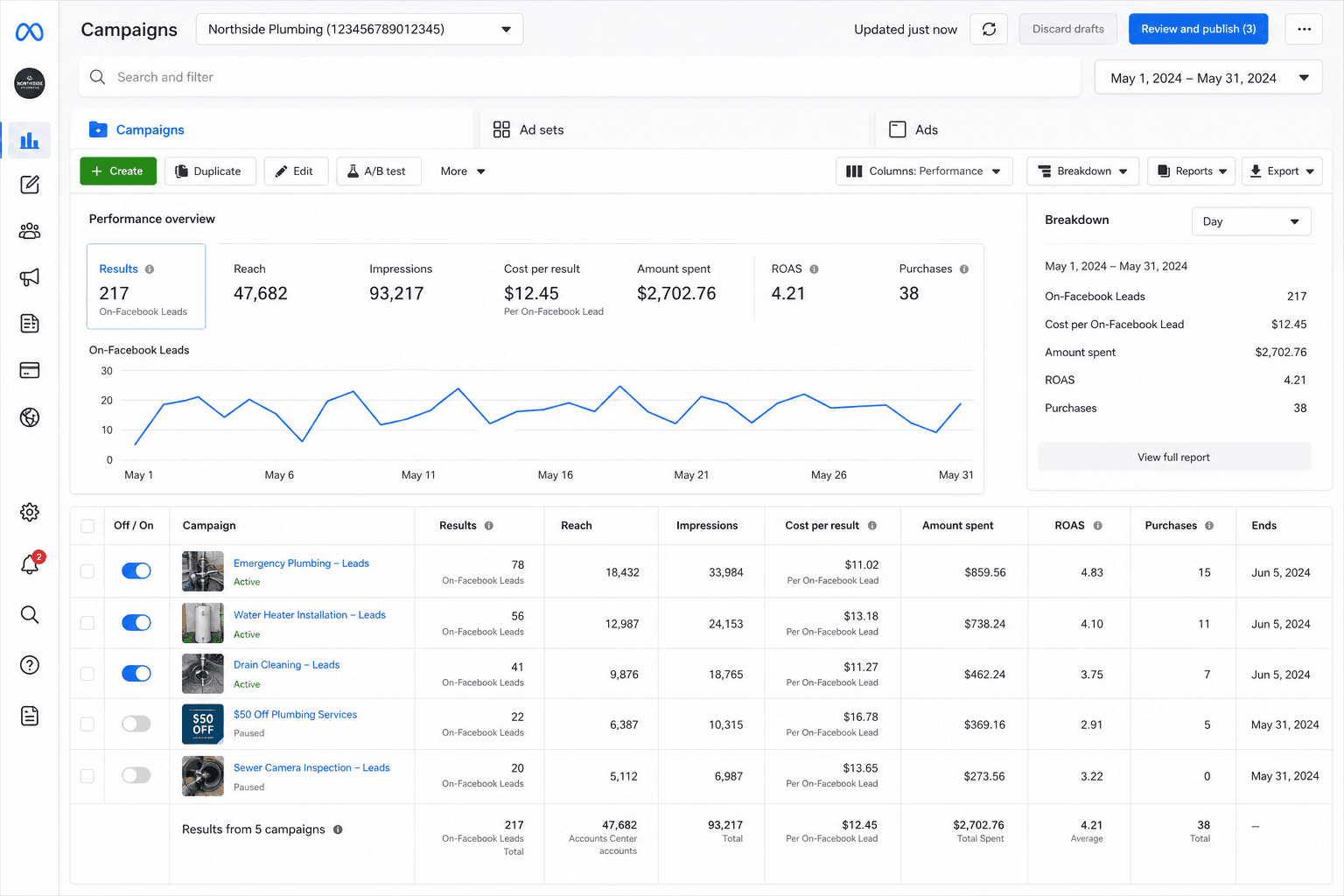
Healthy reporting connects spend to territory, platform role, search terms, creative, landing-page behavior, intake quality, evaluation, client outcome, and revenue value. The goal is not more charts. It is a shorter path from evidence to the next decision.
META_ADS_MANAGER.fig
ROAS WITHOUT THE VANITY
ROAS is attributed revenue divided by ad spend. This planning model makes the assumptions underneath that ratio visible, but a real target should also account for gross margin, delivery cost, capacity, payback timing, and attribution confidence.
Directional planning model—not a promise of results.HOW WE RUN MEDIA / CONTROL ROOM
Every phase has a reason, a success condition, and enough signal to protect the account from random changes disguised as optimization.
We define the services, locations, capacity, payer or customer constraints, expected client value, allowable acquisition cost, and the qualified outcome the campaign should optimize toward.
Unit-economics modelSearch terms, competitor presence, audience signals, service radius, exclusions, local capacity, seasonality, and historical performance become a channel and geography plan.
Demand + territory mapWe organize campaigns by intent and business objective, write platform-native ads, define negative keywords, create audiences, and give every budget segment a measurable role.
Campaign architectureLanding pages, proof, forms, calls, chat, scheduling, and response workflows are aligned to the promise and instrumented before spend begins.
Landing + intake flowWe establish a clean baseline, protect budget with exclusions and guardrails, and test one meaningful variable at a time across query, audience, offer, creative, and page.
Test matrix + baselineSearch terms, placement, creative fatigue, conversion quality, intake feedback, budget, and bidding are reviewed on the cadence the data supports—not changed daily to manufacture activity.
Decision log + growth planTHE GROWTH READING LIST
Follow a website inquiry from form submission to human response, with clear ownership, a backup for failed delivery, and useful ways to measure the handoff.
Help families assess your therapy practice with clear service information, team details, usable mobile pages, and an easy way to contact your office.
Generative Engine Optimization explained for therapy practices. Learn how AI-powered search works and why your practice needs a GEO strategy right now.
BEFORE THE FIRST DOLLAR
More spend magnifies whatever already exists: the targeting, offer, page, response workflow, tracking, and capacity. We make those dependencies explicit before scaling.
The right mix depends on where your audience spends attention, how they make decisions, what creative and landing experiences you can support, and what you need to measure. Search and social are two common options, but the plan should start with your audience, goals, geography, and capacity rather than a preset platform list.
There is no universal target. A sustainable ROAS depends on gross margin, delivery cost, sales or intake conversion, client lifetime value, cash timing, and capacity. We set a contribution-aware acquisition target first, then judge ROAS alongside cost per qualified lead, evaluation, client, and payback period.
Enough to generate a useful number of relevant auctions and conversion opportunities without spreading the spend across too many services, locations, or audiences. We estimate expected click cost and conversion rate, then narrow the launch scope until the budget can create a learnable signal.
Yes. Paid media performance depends on message match, page speed, proof, conversion paths, response workflow, and source-to-outcome measurement. We can build the landing experience, calls or forms, analytics, CRM attribution, and privacy-aware conversion events as part of the system.
Fast enough to stop obvious waste and slow enough to avoid reacting to noise. Search-term exclusions and broken tracking may need immediate action, while bidding, audience, creative, and budget decisions require enough volume and time to judge. We document the reason for each material change so learning compounds.
SPEND WITH A THESIS
Bring us the account, the economics, the locations, the intake reality, and the reports nobody fully trusts. We'll turn them into a paid-growth system that learns from outcomes.