Key findings
Where pediatric clinics get their clients changes with size. In the Driftlss Pediatric Clinic Acquisition Study 2026, a phone study of 624 pediatric clinics, referrals carried the smallest clinics, paid ads drove the move from one location to several, and Google Search and AI referrals took a much larger share at groups with five or more locations. Ads give a small clinic a predictable way to grow, and search and AI visibility built early carry the clinic once it is larger.
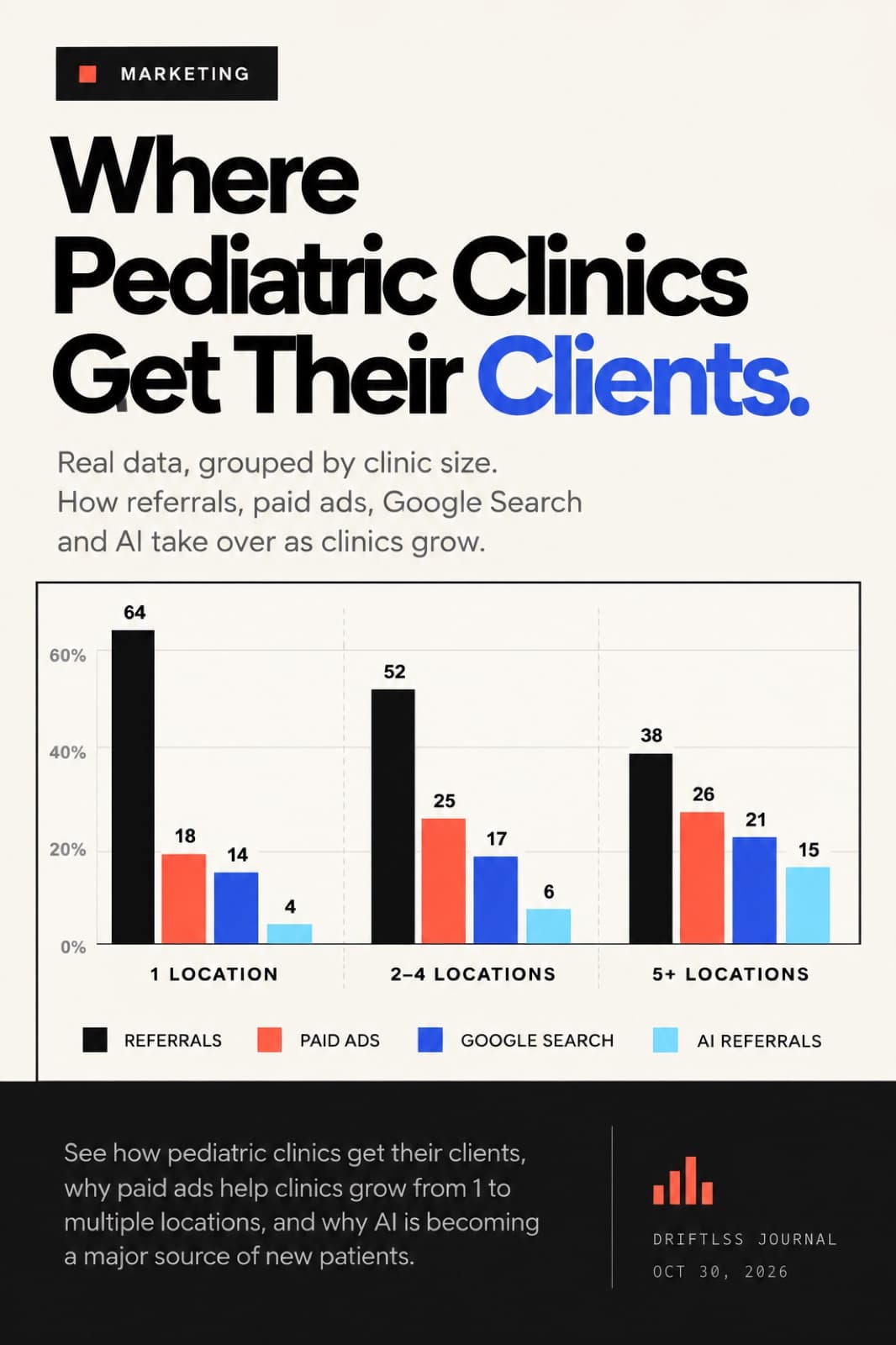
- Referrals and word of mouth brought in 64% of new clients at single-location pediatric clinics. - Paid ads on Google and Meta grew from 18% of new clients at single-location pediatric clinics to 25% at clinics with two to four locations. - Paid ads leveled off past four locations, at 26% of new clients for pediatric groups with five or more locations. - Google Search brought in 21% of new clients at pediatric clinics with five or more locations, up from 14% at single-location clinics. - AI referrals made up 15% of new clients at pediatric clinics with five or more locations, nearly four times the 4% at single-location clinics.
Paid advertising is one of the strongest channels for a pediatric clinic trying to grow from one location to several. As clinics keep growing, Google Search and AI referrals take over a larger share of new families. That pattern came out of phone interviews with the owners and leaders of more than 600 pediatric clinics, where we asked one main question: where did your newest clients actually come from?
We grouped the answers by clinic size: single-location clinics, clinics with two to four locations, and groups with five or more. Smaller clinics lean heavily on word of mouth. Growing clinics get a real lift from paid ads. The largest groups bring in a much greater share of new families through organic search and AI. If you want the full picture of what to build at each stage, our healthcare marketing techniques guide covers the how. This post covers the where.
The results
Share of new clients by acquisition channel and clinic size, from the Driftlss Pediatric Clinic Acquisition Study 2026: phone interviews with the owners and leaders of 624 pediatric clinics in September and October 2026. AI referrals are families who asked an AI tool such as ChatGPT for recommendations, were pointed to the clinic, and then contacted it themselves, as self-reported by the family; leads captured by a chatbot on a clinic's own website are not counted.Acquisition channel1 location (463 clinics)2 to 4 locations (97)5+ locations (64)Referrals and word of mouth64%52%38%Paid ads (Google and Meta)18%25%26%Google Search (website forms)14%17%21%AI referrals4%6%15%
1. Single-location clinics rely heavily on referrals
For clinics operating one location, 64% of new clients came from referrals and word of mouth. That makes sense. A small pediatric clinic usually builds its first caseload through local relationships: pediatrician recommendations, parent networks, and families who had a good experience and told someone. Our guide to getting pediatrician referrals walks through how to make that channel easier to work.
Single-location clinics: where new families came from Referrals are valuable, and they come with one major limitation, which is that they are hard to scale. A clinic owner cannot double referrals simply because they want to double the business. Referral volume depends on relationships, reputation and how often families mention the clinic to someone else, none of which an owner controls directly.
Meanwhile, paid advertising accounted for 18% of new clients at single-location clinics, Google Search contributed 14%, and AI referrals represented 4%. For an owner planning to expand, those numbers point at an opportunity. Rather than waiting for referrals to climb on their own, a clinic can use advertising to create a more predictable flow of new inquiries.
2. Paid advertising becomes a major growth driver at two to four locations
Among clinics operating two to four locations, the share of clients coming from paid advertising rose from 18% to 25%, while referrals fell from 64% to 52%. One of the clearest findings in the whole set was that clinics investing in advertising were seeing strong results as they moved from one location into several.
Referrals drop 12 points and paid ads gain 7 as clinics add locations The advantage of advertising is speed. Google Ads reaches parents who are already searching for ABA therapy, occupational therapy, speech therapy and other pediatric services. Meta advertising introduces the clinic to families in its service area who have not started searching yet. SEO typically needs months of steady work before it builds momentum, and paid campaigns can start producing inquiries much sooner. Our Google Ads versus Meta Ads post explains when each one fits.
For a clinic trying to fill its current schedule, lift enrollment, or prove demand before signing a lease on a second location, that speed matters. Our takeaway is that paid advertising is a particularly good investment for a smaller pediatric clinic with plans to expand.
That does not mean advertising guarantees growth. A clinic still needs open capacity, an intake process that answers every inquiry, and the ability to turn inquiries into enrolled families. Ads make the phone ring, and the clinic still has to pick it up.
3. At five or more locations, AI and organic search matter much more
The most interesting shift appeared among clinics operating five or more locations. Paid advertising remained a major channel at 26% of new families, and that share had barely moved from the 25% we saw at two to four locations. We also observed that advertising efficiency began to flatten as clinic operations approached roughly four locations.
Two other channels kept gaining ground at the same time. Google Search rose to 21%, and AI referrals jumped to 15%. That AI figure deserves a closer look, because the share grew with every step up in size.
- Single-location clinics: 4% of clients came from AI referrals. - Clinics with two to four locations: 6%. - Clinics with five or more locations: 15%.
Paid ads flatten past four locations while search and AI keep rising The largest clinic groups received nearly four times the share of AI-referred clients that single-location clinics did. That suggests AI discovery is becoming a meaningful acquisition channel, particularly for larger pediatric organizations. When a parent asks an AI assistant for pediatric therapy recommendations, a clinic with a strong digital presence has a chance to be found without paying for every individual click. Advertising needs continued spending to keep traffic coming, and strong organic visibility keeps generating inquiries over time. If the terms are new to you, our explainer on SEO versus GEO covers how search and AI answers differ.
4. Why smaller clinics should invest in SEO and AI search earlier
There is a reason larger clinics tend to have stronger organic and AI visibility. They generally have more resources to put into their websites, search optimization, educational content and overall digital presence, and those investments take time to pay off. A Google Ads campaign can reach prospective families shortly after launch, while a well-run SEO effort might take several months before it produces meaningful results.
That delayed return makes SEO hard to prioritize for a single-location clinic with a limited budget. Waiting until the clinic has five locations to start building its organic presence creates a different problem, though, because the clinics that invest early get more time to build visibility before they need it.
A single-location clinic that starts building its Google and AI search presence while running paid ads develops two acquisition channels at once. Ads generate near-term inquiries, and search and AI visibility build a longer-term source of demand. By the time that clinic is ready to open its second, third or fourth location, the digital foundation is already in place to support it.
This is where working with an agency that focuses specifically on pediatric clinics makes a difference. A specialized team understands how parents search for pediatric services, the differences between therapy specialties, the weight of local search, and how to build campaigns around enrolled families rather than website traffic. For a smaller practice, that expertise is a way to compete with larger organizations without an in-house marketing department. Our ABA therapy marketing page shows what that looks like in practice.
5. What pediatric clinic owners should actually do
The right plan depends on where your clinic is today and where you want it to go.
If you operate one location: build a predictable flow of inquiries through Google and Meta advertising, especially if you have open capacity or plans to expand. At the same time, start investing in your website, local SEO and visibility in AI search, so those channels are maturing while ads carry the near term.
If you operate two to four locations: keep using advertising to support enrollment and expansion, and start building a stronger organic strategy alongside it. Develop location-specific pages, improve your Google presence, and publish content that answers the questions parents are already asking.
If you operate five or more locations: look hard at how much of your growth depends on paid acquisition. Keep advertising where it performs, and put more weight on organic search, AI visibility and your presence in every market you serve. The goal at this stage is a diversified acquisition system that does not depend on raising ad spend every quarter.
The bottom line
The way pediatric clinics acquire new families changes significantly as they grow. Single-location clinics get nearly two-thirds of their clients through referrals. Clinics expanding into multiple locations see advertising take a bigger share. Among groups with five or more locations, organic Google Search and AI referrals account for a substantially larger slice of new clients.
The full channel mix at each clinic size The lesson is that different channels serve different stages of growth, rather than any one channel beating the rest. For a small pediatric clinic trying to expand, paid advertising is a practical way to generate demand without relying entirely on referrals. A clinic that wants to grow sustainably should start investing in SEO and AI visibility before it becomes large enough to depend on them. The strongest long-term approach pairs the immediate reach of advertising with the compounding returns of organic visibility, and every channel works better when intake answers every inquiry.
If you want help deciding which of these to build first for your clinic, explore paid ads or SEO and AI visibility, then tell us about your practice. We look at your site, your profile and your current inquiry flow before we quote anything, and we usually respond within one business day.
Contact us about marketing your clinic
Frequently asked questions
Where do pediatric clinics get most of their clients?
For a single-location clinic, referrals and word of mouth, at 64% of new families in our results. Paid ads were the next largest source at 18%, then Google Search at 14% and AI referrals at 4%. The mix shifts toward ads, search and AI as a clinic adds locations.
Do paid ads work for a pediatric clinic with one location?
In our results, ads already brought in 18% of new families for single-location clinics, and that share rose to 25% for clinics with two to four locations. Ads work when the clinic has capacity and an intake process that answers every inquiry. They give an owner a lever to pull, which referrals never do.
How many patients come from AI tools like ChatGPT?
Among the clinics we studied, 4% of new families at single-location clinics said they found the clinic through an AI platform. That figure was 6% at clinics with two to four locations and 15% at groups with five or more. These are self-reported discovery sources, so treat them as a floor rather than a precise count.
When should a pediatric clinic start investing in SEO?
Earlier than most owners expect. Search and AI visibility take months to build and then keep producing inquiries without a per-click cost. A clinic that starts while it still has one location has that foundation ready by the time it opens a second or third.
Does this study prove that ads cause clinics to grow?
No. The figures describe where new families came from across clinic size groups. They do not measure advertising return, cost per acquisition, or whether a particular channel caused a clinic to expand. Use them to decide what to build next, then measure your own results.
How we collected this data
The Driftlss Pediatric Clinic Acquisition Study 2026 draws on phone interviews, conducted in September and October 2026, with the owners and senior leaders of 624 pediatric clinics across four specialties: applied behavior analysis (ABA), speech-language pathology, occupational therapy and pediatric dentistry. We spoke with the people closest to intake and growth at each clinic, because they know where new families come from, and asked each of them for their best estimate of how many new clients over the previous 12 months came from each channel, along with how confident they were in those estimates. Only clinics whose leaders rated their confidence at 75% or higher are included.
We grouped every clinic by its number of locations and report the average share of new clients each channel brought in across the clinics in each group, with every clinic weighted equally. The single-location group included 463 clinics, the two-to-four-location group included 97, and the five-or-more group included 64. Paid ads cover Google and Meta campaigns. Google Search covers families who found the clinic organically and reached out through its website. AI referrals are families who asked an AI tool such as ChatGPT to recommend clinics, were pointed to this one, and then reached out on their own. The category does not include leads captured by a chatbot on the clinic's own website.
Clinic names were removed once the interviews were complete, so every figure in this post is anonymous and no single practice can be identified from it. The numbers reflect what clinic leaders reported rather than data pulled from tracking software. Treat them as a clear picture of where clinics see their families coming from, and as a starting point for measuring your own. The full study methodology covers the exact questions, how clinics were chosen and the study's limitations.
*Research note: These figures describe the distribution of reported patient acquisition sources across clinic size groups. They do not independently establish advertising ROI, cost per acquisition, or whether a particular marketing channel caused clinics to expand. AI referral figures are based on self-reported discovery sources.*